
Safety
Safety & right of way
Kite safety is everyone's responsibility. This page covers the essential right-of-way rules, kite etiquette, and safe practice guidelines that every LKSA rider should know and follow — whether you are a beginner heading out for the first time or an experienced rider helping to set a good example on the water.
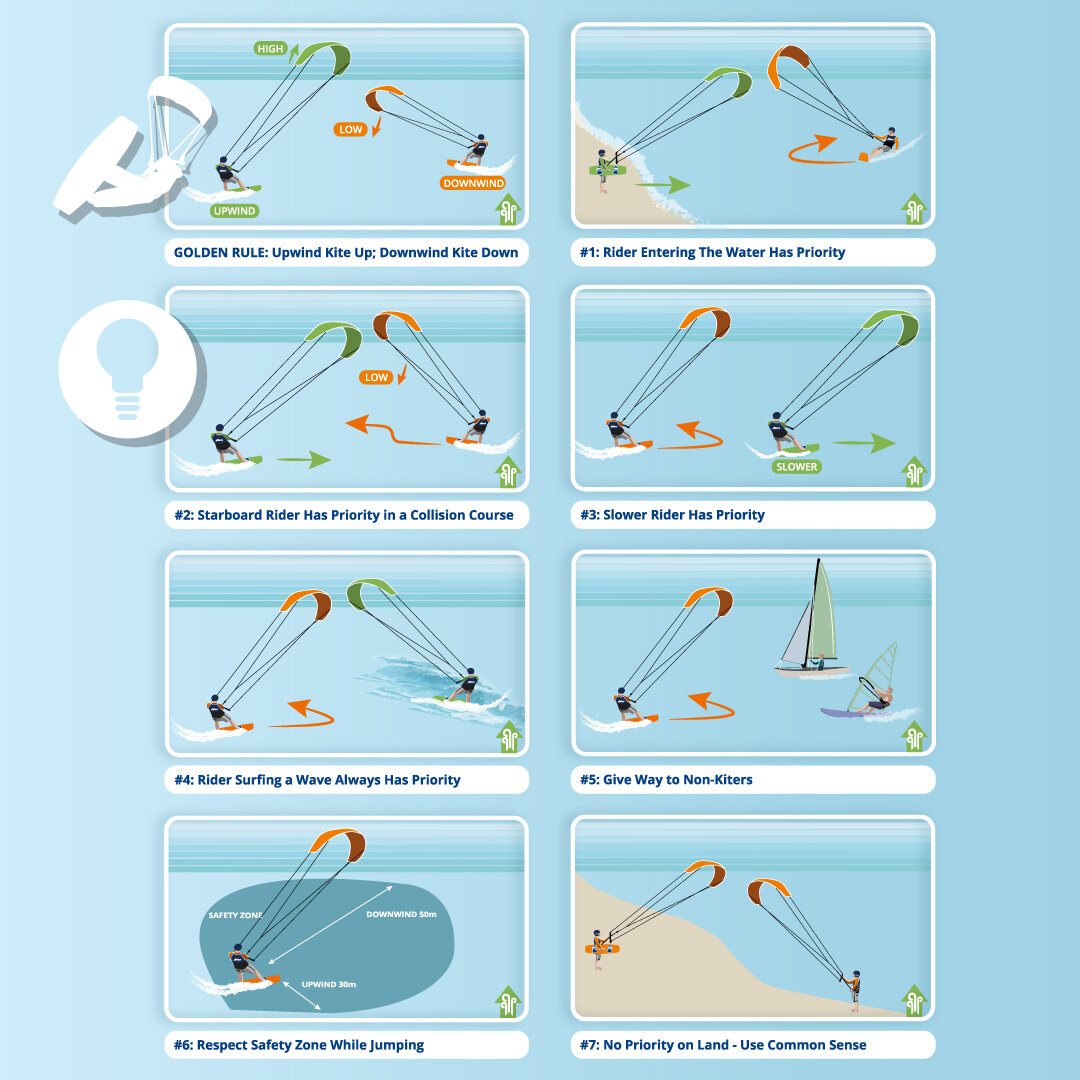
Upwind kite up — downwind kite down
Whenever you pass another rider, keep your kite high if you are upwind of them, and low if you are downwind. This prevents lines from crossing and is the foundation of all kite etiquette on the water.
The 7 right-of-way rules
Rider entering the water has priority
A rider launching from the beach and entering the water has priority over one approaching shore. Give them space and a clear path.
Why this rule exists — A kite on land is the moment of greatest danger: the rider has less control and is closer to beach users, obstacles, and other kites. Giving priority to riders entering the water gets them into a safer environment faster. If you are already on the water and approaching shore, wait for a safe moment to land rather than cutting across someone launching.
Starboard rider has priority
When two riders are on a collision course on opposite tacks, the rider on starboard tack has priority. The port tack rider must change course and pass downwind with kite low.
For the avoidance of doubt — Starboard tack in kitesurfing means you are riding with your right hand and right shoulder forward (heel side). The wind is coming from your right side. In this position, the kite is typically on the right side of the wind window, and you have the right of way over riders on port tack.
Slower rider has priority
When two riders travel in the same direction, the overtaking or faster rider must keep clear of the rider ahead. Do not cut across or pressure a slower rider.
Rider surfing a wave always has priority
A rider riding a wave has priority over any rider who is jumping, crossing, or riding flat water in the same zone. Wait for them to finish the wave.
Give way to non-kiters
Always give way to swimmers, windsurfers, sailors, paddleboarders, and any other water users. Kites are large and fast — the responsibility is always on us.
Respect the safety zone when jumping
Before attempting a jump, ensure you have at least 50m downwind and 30m upwind clear of other riders, swimmers, and obstacles. If there is any doubt, do not jump.
No priority on land — use common sense
On the beach, there are no formal right-of-way rules. Be courteous, keep launches and landings safe and organised, and help other riders when needed.
Before you launch
- When you arrive at a beach, look around and do a basic safety assessment. In the UK, always set up at least 30m upwind from groynes and other obstacles.
- Check the weather forecast before you leave home — make sure the conditions are suitable for the kite you have selected and your capabilities.
- Be aware of meteorological squalls. These can often be seen approaching as a band of dark cloud reaching all the way down to the sea surface, and can bring very high winds for several minutes with little warning. If you see one developing, get off the water in plenty of time.
- Learn with a qualified school before riding independently. Never self-teach with a kite.
- Check wind strength, gusts, tide, and local hazards on arrival, and confirm the spot suits your current level.
- Use modern, well-maintained equipment and know how to fully depower and release your kite.
- Keep clear of swimmers, beach users, launching and landing areas, and congested zones.
- Do not leave your kite unpiloted on the beach where it can create a risk to others.
- Let someone know where you are going and when you expect to be back.
On the beach and near shore
- Keep launches and landings well organised and clearly separated from other beach users.
- Always ask for or offer assistance when launching or landing — never launch solo in crowded conditions.
- Near shore, slow down early and prioritise control over performance.
- Use a leash at all times and keep your safety release accessible and tested.
- Beginners should always ride with a more experienced buddy until confident and competent.
Insurance & BKSA membership
Kitesurfing involves real risk to yourself and to others. Third party liability insurance is not optional — it is essential. If your kite or lines injure another person or cause damage to property, you are personally liable without it.
BKSA membership includes insurance cover arranged on behalf of all members, which covers:
- Third party liability — cover for claims brought against you for injury or damage caused to others. Claims must be brought under UK jurisdiction for cover to operate.
- Personal accident cover — a benefits policy covering you for injury sustained while kitesurfing.
- Worldwide cover — you are insured when riding abroad (subject to the policy, excluding sanctioned countries and destinations against Home Office travel advice), up to 90 days per membership year.
- All kite disciplines — kitesurfing, wingfoiling, land buggying, and other kite disciplines are all covered.
BKSA membership insurance does not replace travel insurance. If you are travelling abroad you should also purchase a suitable travel policy separately.
See the membership page for costs and how to join, or visit BKSA membership FAQ for full policy details.
📞 In an emergency
If someone is in distress in the water — call 999 and ask for the Coastguard immediately. Do not hesitate.
- Person in distress in the water: call 999 and ask for the Coastguard.
- Lost equipment (board or kite): call the Coastguard. Even if no one is in danger, they need to know so they do not launch a search for a rider who may no longer be in the water.
- Found equipment with no owner visible: check around the beach first — the owner may be nearby. If you cannot find them, call the Coastguard. They would much rather be informed than unknowingly begin a search for someone already safe on shore.
First aid: if you carry a first aid kit, make sure you know where it is and that others in your group know too. A few minutes' preparation could make a real difference in an emergency.
In the UK, the Coastguard can be reached by calling 999 (ask for Coastguard) or on VHF Channel 16 if you have a marine radio.
Useful links
- British Kitesports (BKSA) — the national governing body. LKSA is a BKSA affiliate club.
- IKO (International Kiteboarding Organisation) — international standards and instructor certification.
- UK kite spots guide — spot-specific information including conditions, hazards, and restrictions.
Important note
This page is a practical summary intended to support good habits on the water. It is not a substitute for professional instruction, local spot-specific rules, or the full guidance provided by British Kitesports and IKO. Always defer to local authority rules at any given spot.
Sources: IKO kite etiquette guidance; British Kitesports kitesurf information.